Nootropics and Caffeine: Everything You Need To Know

Most of us rely on caffeine to get through busy mornings, long workouts, study nights, or that mid-day slump. But as brain-boosting supplements gain traction, people are beginning to ask something new: is caffeine a nootropic or just a stimulant?
This guide breaks down how caffeine fits into modern nootropic formulas, why the pairing works so well, and how smart combinations of nootropics and caffeine can deliver focus, clarity, and consistency without the jitter–crash cycle many people try to avoid.
Whether you’re training, competing, studying, or just trying to stay mentally sharp through a demanding day, you’ll walk away with a clear understanding of how caffeine interacts with nootropics, when the combination excels, and what to watch out for.
What Exactly Is a Nootropic?
At its core, a nootropic is any substance, natural or synthetic, that supports cognitive functions like:
- Focus
- Memory
- Mood
- Motivation
- Mental clarity
- Processing speed
People often associate nootropics with “smart drugs,” but many of the best-performing nootropics are nutrients or plant compounds your brain already uses every day. That’s why one of the most common questions people ask is: Is caffeine a nootropic, or is it just a stimulant?
The truth is more nuanced… and way more interesting.
So, Is Caffeine a Nootropic?
Short answer: yes.
Caffeine is technically a stimulant, but it also improves alertness, reaction time, motivation, and mental performance. Because those outcomes overlap with traditional nootropic benefits, many researchers now classify caffeine as a nootropic, especially when paired with other brain-supportive ingredients.
That’s why people searching “Is caffeine a nootropic?” often find mixed answers. Caffeine alone behaves more like a stimulant. But caffeine combined with nootropics behaves like a performance-enhancing cognitive tool with balanced benefits.
It’s the combination, not just the caffeine, that matters.
Why Caffeine Works the Way It Does
Caffeine doesn’t just “wake you up.” It works by blocking adenosine, a neurotransmitter that signals tiredness. When adenosine is blocked, dopamine and norepinephrine rise, which increases alertness and focus.
But caffeine alone also has limitations:
- It can cause jitters
- It may trigger anxiety in sensitive individuals
- It can lead to energy crashes
- Higher doses offer diminishing returns
That’s where nootropics and caffeine start to shine as a team; nootropics smooth out caffeine’s rough edges while amplifying the focus benefits.
Do Nootropics Have Caffeine? (And Should They?)
Many nootropics are completely caffeine-free, like L-Tyrosine, Huperzine-A, Alpha-GPC, and nooLVL®.
But some nootropic formulas intentionally include caffeine because it plays well with cognitive enhancers. The key is dosing. An innovative formula doesn’t overload you with 250–300 mg like an energy drink. Instead, it uses enough caffeine to support alertness and enough nootropics to provide clarity, calm, and sustained performance.
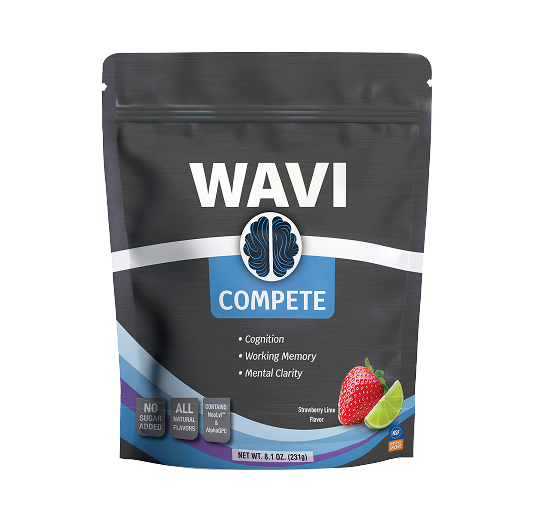
Wavi’s COMPETE is a great example. It contains 75 mg of naturally derived caffeine—roughly the equivalent of a small coffee—paired with synergistic nootropic ingredients such as L-theanine.
This balance is what helps smooth caffeine’s stimulation, reducing the typical crash and turning it into a more controlled, reliable cognitive tool.
So yes, some nootropic formulas include caffeine, but not because caffeine is required. It’s included because, when properly balanced with complementary ingredients, it enhances focus and sustained performance rather than creating spikes and drops.
How Nootropics Improve Your Caffeine Experience
If caffeine sometimes feels too sharp, too short-lived, or too inconsistent, adding nootropics changes everything.
Here’s how the best nootropic ingredients modify caffeine’s effect:
1. L-Theanine — Smooths caffeine’s edges
L-Theanine promotes calm alertness by increasing alpha brain waves. When paired with caffeine, it reduces jitters and creates a relaxed but highly focused mental state.
This is one reason gamma waves, which often appear during deep concentration, are more prevalent in people who use the caffeine and L-Theanine combination.
2. Alpha-GPC — Supports memory & mental clarity
While caffeine sharpens alertness, Alpha-GPC supports the neurotransmitter acetylcholine, improving memory, accuracy, and mental endurance.
It’s the difference between feeling awake and actually performing well.
3. L-Tyrosine — Helps you stay sharp under stress
Stress depletes dopamine and norepinephrine, both of which are essential for focus. L-Tyrosine replenishes them, helping your brain stay resilient during periods of stress, competition, or cognitive fatigue.
4. nooLVL® — Enhances blood flow & processing speed
Caffeine wakes you up, but nooLVL® helps you think faster. Increased nitric oxide improves blood flow, supporting sustained focus without the crash.
5. Huperzine-A — Extends cognitive endurance
This ingredient prevents the breakdown of acetylcholine, boosting learning, reaction time, and mental stamina, especially when paired with caffeine.
This combination is why many athletes, students, and gamers prefer nootropic drinks over traditional energy drinks. You don’t just feel awake, you feel switched on.
Is Caffeine a Nootropic on Its Own? It Depends.
Let’s revisit the core question: Is caffeine a nootropic?
On its own, caffeine offers cognitive support but comes with side effects for many people. In the world of performance nutrition, caffeine becomes a nootropic when:
- the dose is balanced
- the source is clean
- it’s paired with complementary nootropics
- the formula prevents crashes
- the experience boosts cognition, not just wakefulness
This is why stacked formulas are becoming the new standard in mental performance supplements.
Why Nootropics and Caffeine Belong Together
Caffeine brings intensity.
Nootropics bring control.
Together, they create cognitive performance without chaos.
Here’s why the combination works so well:
|
Caffeine Alone |
Nootropics Alone |
Combined Effect |
|
Fast stimulation |
Balanced neurotransmitters |
Clean, controlled focus |
|
Increased alertness |
Reduced stress & jitters |
Calm energy |
|
Short-term performance |
Long-term cognitive support |
Extended mental stamina |
|
Risk of crash |
Smoother brain chemistry |
Stable energy curve |
This explains why people searching “Do nootropics have caffeine?” often end up learning that caffeine isn’t the problem; how it’s used is the problem.
How Much Caffeine Should a Nootropic Formula Have?
Most research points to the 50–100 mg range for cognitive performance without overstimulation.
This amount allows caffeine to act like a nootropic, not like a jolt.
High doses create spikes and crashes. Low doses paired with nootropics create sustained, usable focus. This is one reason regulated energy formulas are replacing sugary energy drinks in esports and athletics.
When you evaluate a formula, the question isn’t only “Is caffeine a nootropic?”, but “Is the dose optimized for nootropic synergy?”
5 Benefits of Combining Nootropics and Caffeine
Here are the cognitive advantages most people notice:
1. More balanced energy
Instead of a sudden peak, you get a smooth incline and a gradual taper.
2. Sharper, calmer focus
The 1:1 or 1:2 ratio of caffeine and L-Theanine combination is famous for increasing concentration without tension.
3. Better stress response
Nootropics like L-Tyrosine help maintain clarity under pressure.
4. Improved reaction time
Caffeine, Huperzine-A, and nooLVL® work together to support faster processing and decision-making.
5. Mental endurance
Nootropics help keep your neurotransmitters functioning consistently through long hours of work, training, or gaming.
This is also why many performance formulas consider both stimulation and recovery in their design. For example, discussions around energy benefits often describe how balanced stimulation supports longer focus windows without overstimulation. Conversations around health benefits help place cognitive performance in the context of long-term wellness, rather than focusing on short bursts of energy.
Is It Safe to Combine Nootropics and Caffeine?
For most people, combining nootropics and caffeine is safe when doses are reasonable.
Moderate caffeine balanced with L-theanine—often at a 1:1 or 1:2 ratio—can promote smoother energy, fewer jitters, and more controlled focus compared to caffeine alone.
High caffeine intake is where problems arise. But moderate caffeine paired with cognitive-support ingredients is far gentler on the nervous system.
This is why many athletes, esports professionals, and entrepreneurs gravitate toward nootropic blends: they get performance benefits without the crash cycle.
So when people ask “Do nootropics have caffeine, and is it safe?” the real answer is that smartly formulated blends are safer than high-caffeine drinks.
When to Use Nootropics With Caffeine
You’ll benefit most from the combination when you need:
- sustained focus
- heightened reaction time
- sharper problem-solving
- motivation and drive
- improved mental clarity
- performance without overstimulation
Everyday use cases include:
- training sessions
- competitive gaming
- exam preparation
- creative work
- high-pressure job tasks
- long meetings or presentations
A clean, effective formula should:
- keep caffeine under 100 mg
- include calming agents like L-Theanine
- support neurotransmitter production
- provide long-term cognitive support
- avoid sugar or artificial overstimulants
A well-constructed nootropic blend usually pairs moderate caffeine with amino acids, choline donors, and plant extracts that steady the stimulant effect rather than amplify it. That’s the philosophy behind formulas like Wavi COMPETE, which combine caffeine with supportive ingredients to create a cleaner, more controlled mental lift.
Final Thoughts: So, Is Caffeine a Nootropic?
Yes, in the right formulation and the correct dose.
On its own, caffeine is simply a stimulant. However, when combined with amino acids, choline donors, nitric oxide boosters, and adaptogenic support, caffeine becomes a nootropic component rather than just an energy spike. You don’t only feel awake, you think more clearly, react faster, and stay composed under pressure.
That’s the real advantage of pairing nootropics and caffeine: performance without volatility.
Experience the focus nootropic that works as hard as you do, Wavi COMPETE. Order now!